Why Mature Trees Lean After Storms: The Root System Problem
“This is exactly why I will be using Leaf Tree in the future for professional pruning and upkeep…Jeff is not only extremely knowledgeable, but passionate about tree health and wellness. I highly recommendation using Leaf Tree for all your tree needs!”
– Tim (Google Review)
Jeff Hempel
TX-4962A
ISA TRAQ
Over 90 5-Star Reviews On Google!
storms, tree problems
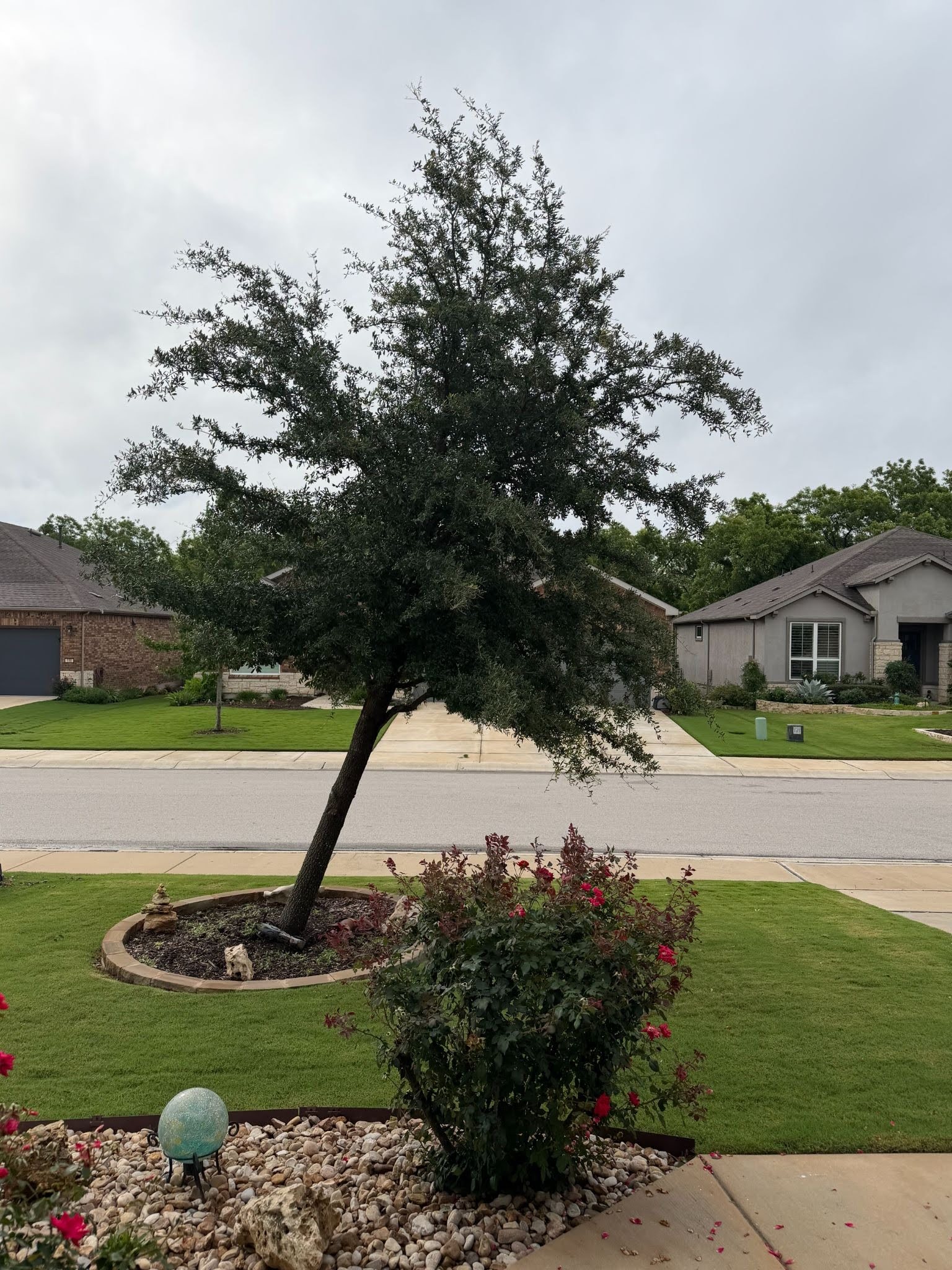
After this week's storms, we received calls from property owners with trees that survived the wind but are now leaning at severe angles. A tree leaning after a storm is telling you something important about its root system.
Most property owners don't understand what causes a tree to lean after a storm. Understanding the root causes helps you prevent this problem before the next severe weather event hits Central Texas.
What Causes Trees Leaning After Storms?
A tree suddenly leaning after a storm isn't necessarily a failure. The tree survived the wind event. But something about that tree made it vulnerable to leaning rather than standing firm.
The answer is usually the root system. Over-irrigation is one reason trees develop shallow, unstable root systems. But it's not the only reason. Sometimes it's how the tree was planted originally. Sometimes the soil around the root ball never properly integrated with surrounding soil. Sometimes roots hit bedrock or clay layers and couldn't establish deeper anchoring. Sometimes years of compacted soil from vehicles or foot traffic prevent root expansion.
Whatever the cause, a tree leaning after a storm is telling you something: that tree's root system isn't holding it securely in the ground.
Over-Irrigation and Shallow Root Systems
One of the most common causes we see is continuous bubble irrigation on mature trees.
Here's how it works: bubble emitters deliver water slowly and consistently to the upper soil layer. Roots naturally follow available water. If water is always present in the top 12-18 inches of soil, roots never need to develop deeper. Year after year of this shallow watering creates a root system that never extends down and out the way mature trees need.
When a tree is young and newly planted, some establishment watering makes sense. Shallow roots are normal while a young tree is establishing. But established mature trees don't need constant shallow watering. They need deep root systems that can anchor them against wind and weather.
If bubble irrigation stays on indefinitely, mature trees never develop those deep anchoring roots. The root system stays contained in the upper soil layer. When a storm brings strong winds, the tree has nothing holding it in the ground except shallow roots that can't handle the force.
Other Reasons for Shallow Root Systems
Over-irrigation isn't always the culprit. Trees also develop shallow root systems when they're planted improperly. Trees planted too deep, with roots kinked or circling in the soil, develop compromised root systems from the start. Sometimes a tree was planted with the root ball never properly integrated into surrounding soil, so roots stayed contained in the original planting soil rather than expanding outward.
Soil conditions also matter. Clay layers, bedrock, or other subsurface obstacles can prevent roots from establishing the deep anchoring systems they need. Compacted soil from vehicles or foot traffic can limit root expansion.
What Property Owners Face When Trees Lean
When a tree is leaning after a storm, property owners face a difficult situation. The tree is still alive. It still has foliage. But finding professional help to address it is harder than expected.
We had a call this week from a property owner with a mature tree leaning at a severe angle. He'd already called six other tree companies before reaching us. Every single one told him the tree wasn't savable or they don't do that kind of work. The problem is that correcting a leaning tree is complex work that falls outside what most tree services routinely handle. Many stick to removal or maintenance. Few attempt to straighten and stabilize a severely leaning tree.
But with the right approach and equipment, these trees can sometimes be saved.
How We Corrected a Leaning Tree This Week
The property owner we mentioned had called multiple companies. Most wouldn't attempt to help. When we arrived to assess the tree, we developed a plan.
Our approach: we used a truck and rope system to carefully pull the tree back upright. The tree needed leverage to come up safely. We positioned the truck to pull at an angle that gradually brought the tree back to vertical.
Once upright, we stabilized it with straps and a stake system. But this is temporary. Straps and stakes can only hold a tree for a few days. We'll return to adjust the support system and develop a longer-term plan for stability.
The point is: this tree was saved from removal. The property owner was relieved. Most other companies wouldn't even attempt it. But with expertise and equipment, we found a solution.
Another Leaning Tree Coming Next Week
We have another property owner dealing with a similar situation. His tree is also leaning severely after the storms. He also called multiple companies and heard "can't help you" from most of them. He's in the same position: uncertain if the tree can be saved, uncertain if there's enough leverage to pull it upright, but hopeful.
This scenario is becoming more common as severe storms impact Central Texas. Property owners with mature trees face uncertainty about whether their trees are salvageable or if removal is necessary.
FAQS About Leaning Trees
Can Trees Leaning After Storms Be Saved?
The answer depends on whether there's a leverage point to work with.
The key factor in straightening a leaning tree is having something to pull against. If there's enough leverage available through the tree's structure or surrounding anchoring points, we can work with it. If there's not enough leverage, straightening becomes impossible regardless of how stable the tree might be once upright.
Every tree and every situation is different. Some trees have good structural points for rigging and pulling. Others don't. Some soil conditions allow for successful re-anchoring after straightening. Others don't. Professional assessment determines whether your specific tree can be corrected or if other options are better.
What Needs to Happen After a Tree Is Straightened
If we do straighten a leaning tree, that's not the end. The tree needs support while its root system re-establishes and strengthens.
Temporary stabilization with straps and stakes is just the first step. Over the following weeks and months, as the tree begins to stabilize naturally, the support system needs adjustment. The goal is gradually reducing external support as the tree's own root system strengthens enough to hold it.
We also need to address whatever caused the shallow roots in the first place. If it was bubble irrigation, that needs to stop. If it was poor initial planting, we might need to work on encouraging deeper root development. The goal is a tree that can stand on its own without external support.
This is longer-term work. It's not a quick fix. But done properly, a tree that was nearly lost to removal becomes established and stable again.
Preventing Trees Leaning After Storms
The best approach is prevention. Not all causes of shallow roots can be prevented, but some can.
If you have bubble emitters on mature trees, consider stopping them. Mature established trees in Central Texas don't need constant shallow watering. They may actually be weaker for it. Shallow roots mean unstable trees during storms.
For new tree plantings, be realistic about how long establishment watering continues. Young trees need some supplemental water while they're establishing. But this shouldn't continue indefinitely. At some point, the tree needs to develop its own deep root system. Ongoing shallow irrigation prevents that development.
Proper planting depth and technique matter too. Trees planted too deep or with kinked roots start with compromised root systems. Proper planting gives trees the best chance to develop strong anchoring.
Watch your mature trees for signs of stress or unusual conditions. If a tree seems unstable or is leaning for no obvious reason, professional assessment makes sense. Better to address problems before a storm reveals them dramatically.
What to Do If Your Tree Is Leaning After a Storm
If you have a tree leaning after the recent storms, don't assume it needs to come down. Don't accept the first "no" from tree companies you call.
Contact an ISA Certified Arborist for assessment. We've straightened trees that others said weren’t savable.. We have equipment and experience with this specific problem. Not every tree can be saved, but you won't know until you get a professional evaluation.
Don’t wait too long to contact someone. The longer a tree leans, the more stress is on the partially uprooted root system.
If you have a tree leaning after a storm, the right first step is professional assessment. Not all leaning trees can be straightened and not all are worth straightening. But you won't know unless someone actually evaluates your tree instead of just recommending removal. Contact us for an assessment of your specific situation.
What Our Clients Are Saying
“Jeff, a certified arborist with extra training and lots of experience in the area, fit me into his schedule and showed up promptly, on very short notice. We did a walk-through of the property, advising on what trimming was most beneficial and helping me understand things to look for as potential problems with tree health. We picked a few trees that merited attention and a proposal for trimming followed. When the crew came out, at the expected time, we confirmed the work to be done before they started. Trimming was well done, quickly, per my requests. Tree canopies look noticeably better, appreciate their attention to balancing their cuts.”
– Mark
“I had a tree health consult with Jeff and it was incredibly informative and comprehensive. He told us all about our main oak that we want to keep healthy and suggested what would help keep the tree healthy and safe. He was not at all pushy on selling future service, but answered every question we had and did not rush through anything. This is exactly why I will be using Leaf Tree in the future for professional pruning and upkeep. It is entirely evident that Jeff is not only extremely knowledgeable, but passionate about tree health and wellness. I highly recommendation using Leaf Tree for all your tree needs!”
– Tim
“Jeff with Leaf Tree Service responded very quickly to our need. We were under a time frame imposed on us by the city. Jeff's crew was able to fit us in and prevented us from being fined. They took the extra steps to ensure the trees would not sprout up & ground the stumps to ensure mowers could keep area maintained. The city inspector wrote an email praising the quality of the job. The care in which jeff's crew took while clearing this brush was amazing & the remaining trees in this area look fantastic. Highly recommend Leaf Tree Service. In fact I am using them each quarter to maintain the other trees on our property. Quality work at a fair price, which is hard to find these days.”
– Rick
Where We're Located
1510 Sam Bass Rd,
Round Rock, TX 78681
(512) 670-6766
info@leaftreeservicesatx.com